
Be Patient But Persistent
System-Level Edition

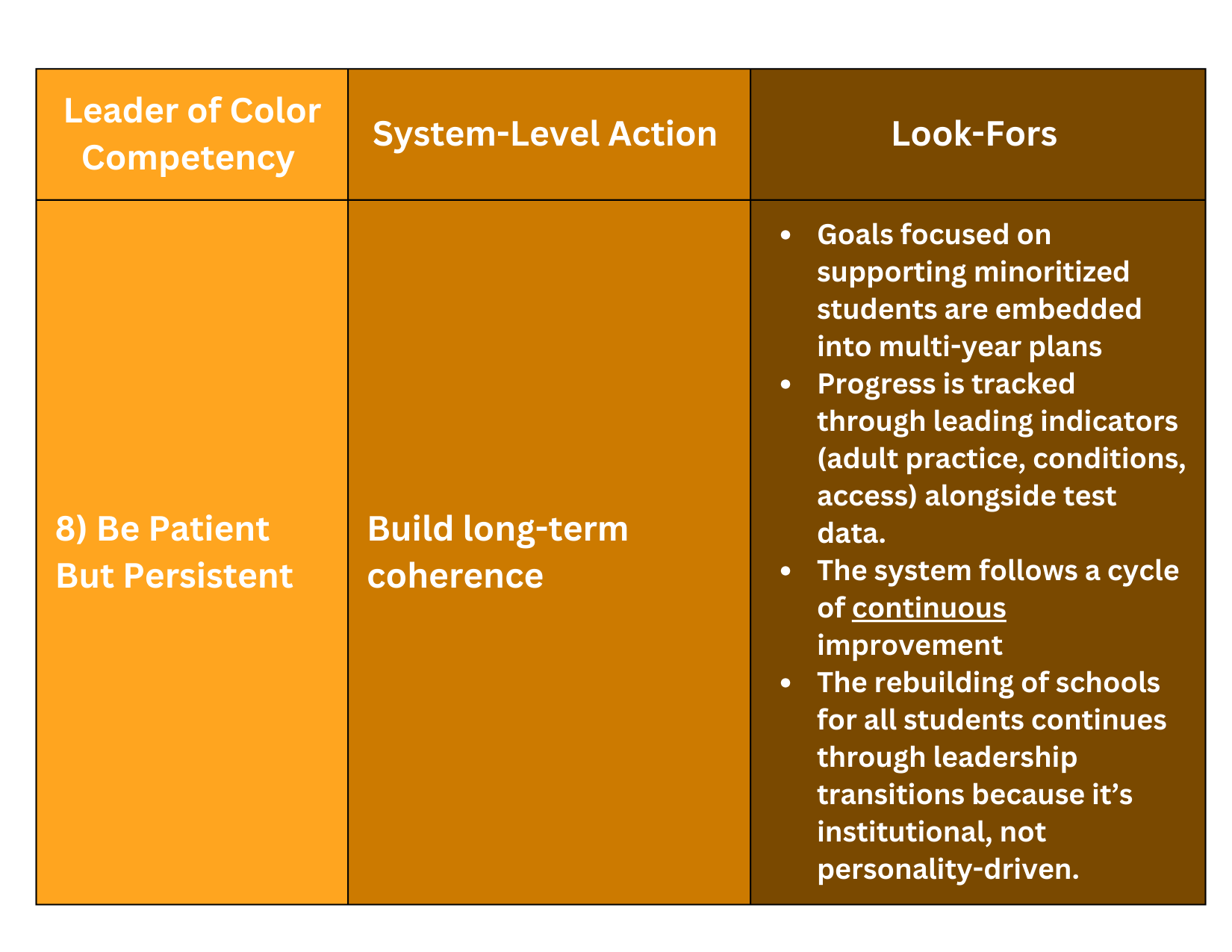
Photo Description: A chart that explains the eighth system-level action aligned to the Leader of Color Competency #8:Be Patient but Persistent from the book, Leading Within Systems of Inequity in Education.
System-Level Action #8: Build long-term coherence
As leaders of color, we often carry a deep urgency to transform school systems because we understand firsthand how harmful unjust systems can be. At the same time, the competency “be patient but persistent” reminds us of a difficult truth: building liberatory education systems takes time. Real change rarely happens through a single initiative or a charismatic leader. It happens when systems are designed so that justice-oriented work becomes part of the water—something that continues regardless of who occupies a particular leadership seat.
At the system level, this means building long-term coherence. School systems demonstrate this action when academic success and belonging for minoritized students are embedded into multi-year strategic plans and budgets rather than framed as short-term programs. Instead of launching a series of disconnected initiatives, leaders align strategy, resources, professional learning, and policy so that the work reinforces itself year after year.
Building coherence also protects leaders from the trap of surface-level activity. Too often, systems respond to inequities with symbolic gestures, one-off trainings, or temporary task forces. Persistent leaders focus instead on policy and infrastructure: how budgets are allocated, how leaders are developed, what metrics are tracked, and what routines hold people accountable.
Most importantly, when systems build long-term coherence, the work survives leadership turnover. Building school systems for all students is no longer dependent on a single champion. It becomes institutional.
For leaders of color who are often asked to carry transformation on their backs, this action is both strategic and sustaining. It shifts the work from heroic effort to durable system design.
Reflection Questions:
For Leaders of Color:
Where in my system is justice-centered work treated as an initiative rather than a long-term strategy?
How am I communicating the deeper why behind creating justice-centered schools so others remain committed even when progress is slow?
What policies or structures could ensure this work continues beyond my tenure?
For School Systems:
Are goals for minoritized students embedded into multi-year strategic plans and budgets?
What leading indicators do we track to measure progress beyond test scores?
What routines (e.g., quarterly reviews, implementation cycles) ensure that the work remains consistent across leadership transitions?
Please leave a comment to let me know what you think about this system-level action. Next week, we will unpack the next action: “Provide political cover and governance alignment.”
Other Writings within Leading-Within!
Every month, I write about what’s happening in the world for me, share an interview with a leader of the global majority, and provide a rundown of what I’m reading, listening to, and watching. Issue #69 -Gray is the latest one.
The Sneak Peeks for Navigating Power, Harnessing Possibility: A Guide for Leading Schools Through Uncertain Times have launched. The latest Sneak Peek is available.
Ways to Partner with Leading-Within, LLC:
Strategic Partnership: Individual coaching and group training for system and school-level leaders who need support in navigating the informal and formal political structures within their organization and community, and want to create systems where their leaders of the global majority can thrive
Resource Development: Develop tools and strategies for leaders of the global majority and those developing their contextual intelligence
Research & Writing: Partner with districts, universities, and organizations to help them assess and document best leadership practices across the diaspora
Reach out to mary@mriceboothe.com to discuss more.
If this is your first time reading, please go back and read my Introductions post.
Thanks for reading! Let me know what you think. If you like it, please share it with your network and don’t forget to hit the “heart” button and leave a comment.