
Create A Coalition
System-Level Edition

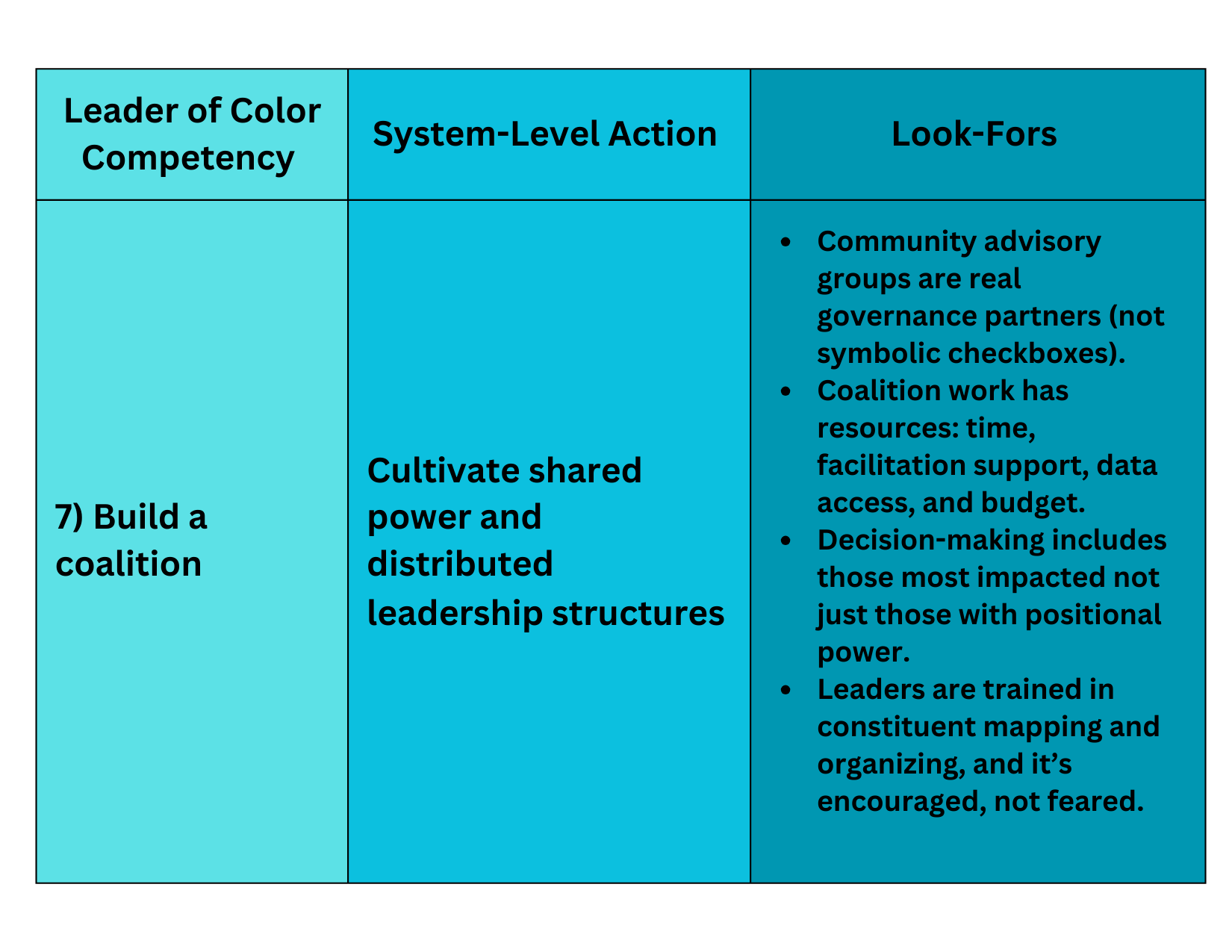
Photo Description: A chart that explains the seventh system-level action aligned to Leader of Color Competency #7: Create a coalition in Leading Within Systems of Inequity in Education.
System-Level Action #7:
For many of us leaders of color, the instinct to build together comes from lived experience. It’s part of our history. It’s in our DNA.
We know that meaningful change rarely happens alone. It requires relationships, shared purpose, and a network of people who are willing to move together. But coalition building should not rely solely on individual leaders navigating systems on their own. Systems themselves must create the conditions for shared power and distributed leadership to be possible.
Cultivating shared power means moving beyond performative inclusion toward real governance pathways for community voice. When systems build distributed leadership structures, they make space for educators, families, students, and community members to participate in decision-making rather than just offer feedback after decisions have already been made.
When systems value leadership skills such as constituent mapping, organizing, and coalition-building, they see engagement with communities as necessary and not advisorial. They recognize that the ecosystem influencing students’ lives extends far beyond the four walls of a school building. Schools sit within neighborhoods shaped by families, faith communities, youth organizations, local businesses, advocacy groups, and civic leaders, all of whom hold perspectives, resources, and influence that can strengthen educational change. Rather than viewing these community members as outsiders or critics, systems that cultivate shared power see them as potential partners in improving outcomes for students.
Ultimately, a system built on distributive leadership structures can expand the imagination of what is possible and create the collective strength needed to navigate complex political and institutional landscapes. We need each other now more than ever, and our systems need to support the building of that container.
Reflection Questions:
For Leaders of Color:
Whose voices and perspectives are missing from your current networks?
What additional layers of partnership could strengthen your coalition’s impact?
For School Systems:
Are time, funding, and facilitation support provided for coalition-building efforts?
Are those most impacted by decisions meaningfully included in decision-making processes?
Please leave a comment to let me know what you think about this system-level action. Next week, we will unpack the next action: “.”
Other Writings within Leading-Within!
Every month, I write about what’s happening in the world for me, share an interview with a leader of the global majority, and provide a rundown of what I’m reading, listening to, and watching. Issue #69 -Gray is the latest one.
The Sneak Peeks for Navigating Power, Harnessing Possibility: A Guide for Leading Schools Through Uncertain Times have launched. The latest Sneak Peek is available.
Ways to Partner with Leading-Within, LLC:
Strategic Partnership: Individual coaching and group training for system and school-level leaders who need support in navigating the informal and formal political structures within their organization and community, and want to create systems where their leaders of the global majority can thrive
Resource Development: Develop tools and strategies for leaders of the global majority and those developing their contextual intelligence
Research & Writing: Partner with districts, universities, and organizations to help them assess and document best leadership practices across the diaspora
Reach out to mary@mriceboothe.com to discuss more.
If this is your first time reading, please go back and read my Introductions post.
Thanks for reading! Let me know what you think. If you like it, please share it with your network and don’t forget to hit the “heart” button and leave a comment.
Loving these posts of yours, Mary. This statement seems obvious, but is often forgotten by leadership: "Schools sit within neighborhoods shaped by families, faith communities, youth organizations, local businesses, advocacy groups, and civic leaders, all of whom hold perspectives, resources, and influence that can strengthen educational change." It is a great reminder of the power of working together.