
Issue 66: Window
Noun. An opening in a wall or roof that allows light and air to pass through, often fitted with a glass pane and a frame.

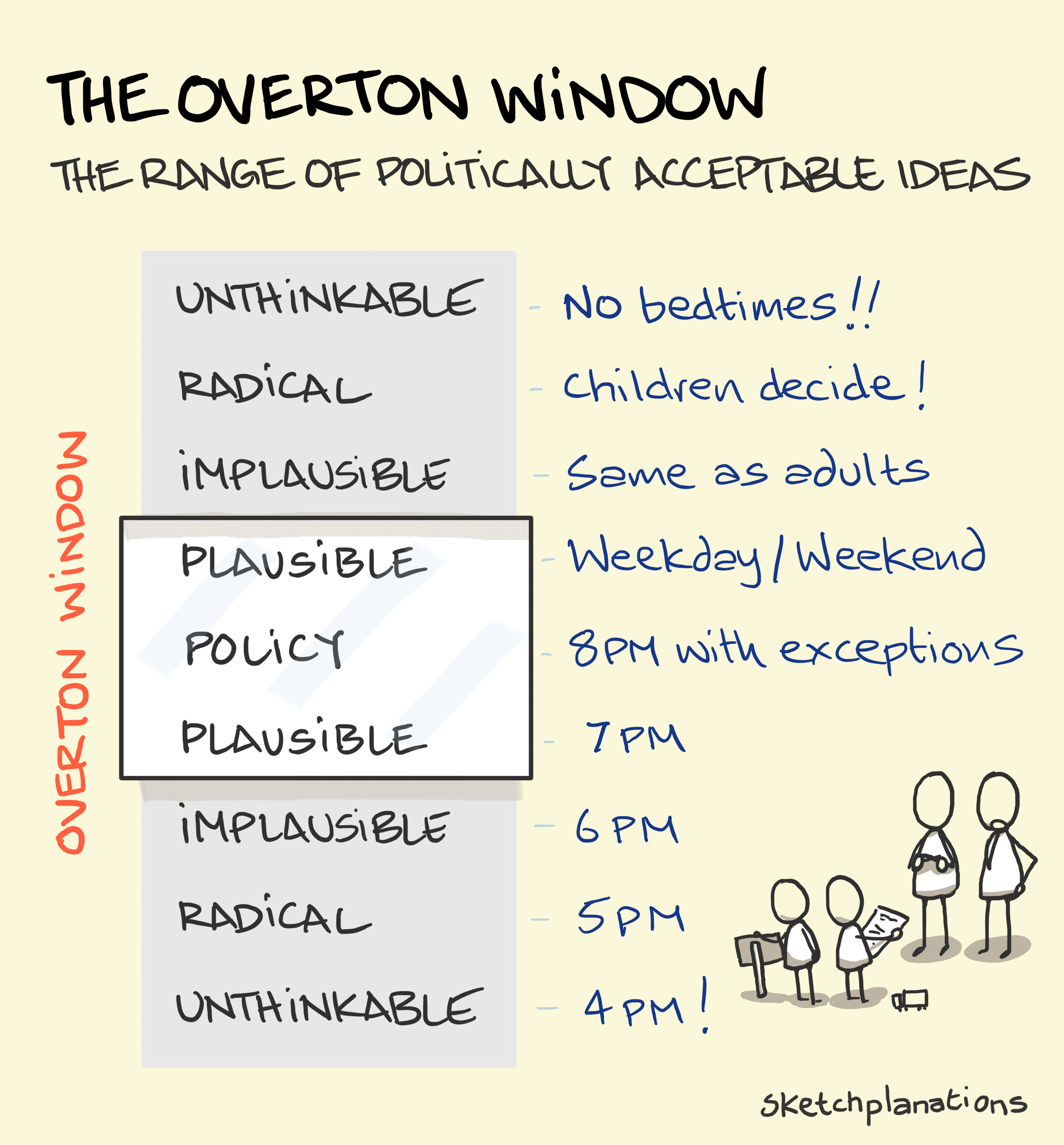
A graphic of The Overton Window is shown with an example of bedtimes for kids. Photo by Sketchplanations
Check-In:
I’m ending 2025 at home. No more travel. No more conferences. No more in-person facilitation. Thirty-one days to be still, reflect on the year, and plan for 2026.
In the past year, work has taken me to Ghana and to many, many US cities, from LA to Washington, DC, from Philadelphia to Jackson.
I have spent short segments of time with superintendents, district leaders, principals, funders, and non-profit leaders. I often leave these spaces and people feeling energized and excited about what’s possible, but frequently wondering if it will last. Leaders are facing tight budgets and enrollment challenges within a system that is being attacked while trying to keep student academic success front and center. I understand if the dreaming they just engaged with during a professional development session with me doesn’t have staying power, but still, our students need us to keep pushing.
I recently listened to an episode of Trevor Noah’s podcast when he mentioned something that immediately caught my attention—the Overton Window. It’s a concept from political science that explains how public opinion defines what’s politically possible at any given moment. Originally called the “Window of Political Possibilities,” it was later named after its creator, Joseph P. Overton. The idea is simple but powerful: there’s a spectrum of ideas ranging from the unthinkable to the widely accepted, and what sits in that “window” determines what leaders can realistically advocate for without losing public support.
What’s fascinating is how that window can move. Over time, ideas that once seemed radical, like universal pre-K or climate-neutral school facilities, can become mainstream through deliberate advocacy and cultural shifts. It made me think of the work of helping district leaders navigate public will and systemic change. For instance, when a district begins talking about community-connected teacher teams or redesigning the central office to center student voice, those ideas might initially sit outside the window of what’s seen as practical or politically viable. But through storytelling, coalition-building, and demonstrating early successes, that window begins to shift.
The Overton Window also reminds me that progress often starts with introducing bold ideas, not necessarily because they’ll be adopted immediately, but because they expand the boundaries of what’s imaginable.
I hope that from my short facilitation sessions, when I encourage district leaders to pilot new talent management strategies or central office structures that challenge traditional hierarchies, we’re not just implementing programs; we’re shifting the window of possibility for what education can be.
How are you using the last month of the year to imagine what’s possible?
#mondaymotivation: “You don’t make progress by standing on the sidelines.” — Shirley Chisholm
Interview with a Leader of the Global Majority:
Lisa was an equity officer for a large district in Virginia. She is currently an education consultant. These comments are the personal reflections of Lisa and her experiences; they do not reflect the opinions of her former employer. Her first excerpt was in Issue #43:Limits.
Mary: What are some of the challenges you face in this role?
Lisa: One of the major challenges is dealing with the pace at which organizations work. You do 1,001 things, so you’re always busy, which is a fundamental tenet of systems of oppression, keeping you so busy that you can’t even be reflective in ways that you could be creative enough to do something different.
Mary: That’s powerful. So, what makes that pace such a problem?
Lisa: Number one, recognizing the pace at which we work is part of the problem. I just talked about being in a meeting until 10 o’clock. What is all of this? But this is our conditioning, right? We don’t even know how to look at our conditioning and what it orients us to, and how it makes us more likely to reproduce the same systems.
Mary: How do you help people see that?
Lisa: The hardest part of the work is getting people present to their own conditions. You can’t change what you can’t see. So part of what I do is use data and stories to help organizations wake up to themselves to see the patterns that show up everywhere. Until we see how our busyness hides the inequities we’re reproducing, we’ll just keep playing whack-a-mole and calling it improvement.
Please let me know if you would like to be interviewed and/or if you would recommend someone to be profiled in this section. I need new interviews!
What I’m Reading, Watching, and Listening To:
READING: Death of the Author by Nnedi Okorafor is a science-fiction novel within a novel set in the US and Nigeria, and Make Your Way Home: Stories by Carrie R. Moore is a series of short stories set across several cities in the deep South. Both books are great conversations about family, place, and community. I got to hear from both authors during the Texas Book Festival, and they were excellent reads!
LISTENING TO: Joy-Ann Reid gives great leadership lessons on this podcast episode of Teach the Babies with Dr. David J. Johns. She talks about the end of her news show, The ReidOut, building her own independent media platform, and why resistance starts with refusing to be silent.
Coming in January 2026!
The conversation around Leading Within Systems of Inequity of Education: A Liberation Guide for Leaders of Color is not over. A new series of posts on what it would look like for school systems to support each of the competencies featured in the book will start in January.
Navigating Power, Harnessing Possibility: A Guide for Leading Schools through Uncertain Times’ book cover and pre-order link will soon be available. We ended November with book endorsements! I’m honored to have folks that I admire read my book in advance and share their impressions. Truly humbling experience. I look forward to sharing their thoughts and thanking them publicly soon. We are officially in production!
How to Continue to Support Leading-Within:
Go to Amazon and rate or review the book there! Reviews are a great way for others to see that this book is worth the time to read.
Post about the book on social media using the hashtag #leadingwithin. Even better if it includes a picture of you WITH the book!
Host a book club with your affinity/ERG group. Two study guides are also available on the ASCD website - one for leaders of color and one for white co-conspirators that are perfect for starting a group conversation. For book clubs with participants who have purchased and committed to reading the book, please reach out to me so I can support your journey!
Connect with me to speak to your organization or group about topics covered in the book, like ‘practicing love and rage’, ‘building a coalition’, and ‘taking a stand’.
If this is your first time reading, please go back and read my Introductions post.
Thanks for reading! Let me know what you think. If you like it, please share it with your network!
Mary,
I really enjoyed this post. I was not familiar with the concept of the Overton Window (and am a little behind on my podcasts right now), so I found it fascinating. I think you are definitely right that this could be something of interest to leaders looking to make systemic change. Great post!
Also...enjoy the time being in one place! Travel is wonderful, but can also be draining.