
Issue 71: Entrepreneur
Noun. An individual who identifies a need or opportunity, creates a business, and assumes the associated financial risks and management responsibilities to turn an idea into a functional venture.

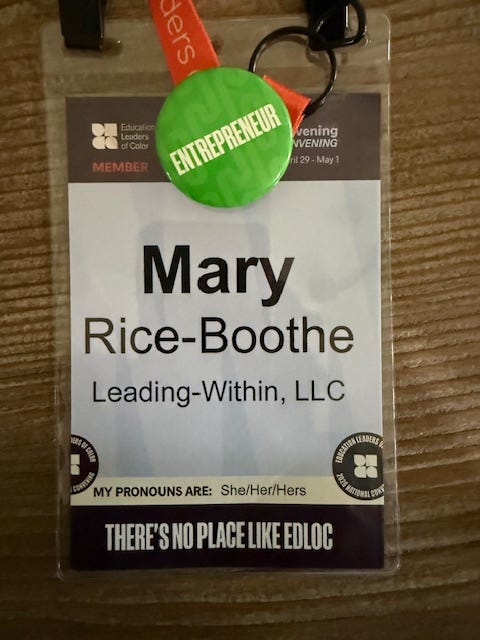
Check-In:
I am a granddaughter of sharecroppers from Arkansas. My father built a construction business in Wisconsin, so I should not be surprised that I sit here in Texas building not one but two businesses (information on both shared below).
Although this building from the ground up is in my blood, the memories of the hardships, dishonest partners, and financial uncertainty that my father experienced are also with me. So, although I have had short stints of working for myself before, I never fully embraced my destiny until the past year.
Black women are the fastest-growing group of entrepreneurs in the United States, launching businesses at rates far outpacing overall growth and now owning more than two million enterprises nationwide (Wells Fargo, 2025). In recent years, these businesses have generated over $100 billion in revenue and created hundreds of thousands of jobs.
Yet, this rise also reflects a deeper story: many Black women are turning to entrepreneurship not just by choice, but in response to persistent barriers in traditional workplaces and limited access to capital (Brookings Institution, 2024; National Women’s Business Council, 2023). The result is a powerful surge in ownership, paired with an ongoing challenge to ensure these businesses can scale and sustain long-term success.
I’ve seen this in my own family and across the world. When I traveled through the marketplaces of Accra, Bali, Kingston, and Kumasi, I saw entrepreneurs everywhere selling everything from cocoa butter to mangoes to jewelry. When talking to locals in all of these places, these businesses provide a living for multiple people, and what seems like a modest stall on the side of a road is a generational family enterprise.
When I was a high school principal, we had an elective course on entrepreneurship. It was pretty popular, and students were always excited about what they were crafting. At the end of the semester, students had to pitch their product and had opportunities to participate in city-wide experiences. In those few weeks of the semester, they learned about developing a business plan, marketing, budgeting, brand engagement, and public speaking- skills that are central to anyone’s success in today’s workforce.
So, as I’m building my skills in areas that my high schoolers were learning a decade ago, I wonder if we missed something in education? Should that elective course have been a mandatory course? The idea of a person working at one company for the rest of their lives or getting a “good union job” left us generations ago, but our education system has not caught up.
Several years ago, at the end of the school year, my son’s teacher produced a PPT slide deck from all of the students in the class. Each slide showed a picture of the student, what they enjoyed about the school year, and what they wanted to be when they grew up. I shouldn’t have been surprised to see so many “YouTube creator” listed.
Our schools are full of students ready to chart their own paths and create roles that we may not have even dreamed of yet, and for many, this will be out of necessity, not just desire. As leaders responsible for their education, are we preparing them for that future?
#mondaymotivation: "Don't follow the path. Go where there is no path and start a trail." ~Ruby Bridges
Interview with a Leader of the Global Majority:
Danya Muniz is a University leader based in Pennsylvania. These comments are the personal reflections of Danya as a parent; they do not reflect the opinions of her employer.
Mary: What have you learned about advocating for your children within the school system?
Dayna: You just have to figure out who to talk to and who needs to talk to whom. And you have to play the political game… You have to understand the context to play the political game of whatever place you’re in.
Mary: Can you share a moment when you had to advocate for your child?
Dayna: I emailed the teachers… ‘Here’s a bunch of resources. It’s really harmful… to place Native people in the past.’ And I got crickets.”
Dayna: Then some of the white parents were like, ‘We’re really concerned.’ And then all of a sudden, the trip was off.
Mary: What does that experience teach us about how schools respond to families?
Dayna: It’s not that [parents] haven’t been speaking… there’s just no listening happening.
Mary: What advice would you give other parents navigating schools?
Dayna: Find your people… but you can’t forget the racialized dynamics of it. It’s naive to think people are going to be treated the same.
Dayna: There is a strategy that has to be in place around who’s going to be the spokesperson… figuring out who the people are is helpful.
Please let me know if you would like to be interviewed and/or if you would recommend someone to be profiled in this section. I need new interviews!
What I’m Reading, Watching, and Listening To:
READING: I followed up Kin by Tayari Jones last month with The Wilderness by Angela Flourno, the story of the friendship of multiple women across decades. The backdrop of the stories is split between LA and NYC, with the characters interacting with several major events over the past few years, including the presidential elections, the racial reckoning, and wildfires. After reading these two books on friendship, I have a desire to go back and read Sula by Toni Morrison- the ultimate novel on friendship, in my humble opinion.
LISTENING TO: This podcast episode of Miseducation was recorded at SXSW EDU in Austin, Texas, on March 9, 2026. Moderated by Salma Baksh, the conversation explored how student journalists can ask hard questions, hold institutions accountable, and drive change in their schools and communities.
WATCHING: Trevor Noah’s newest comedy special on Netflix, Joy in the Trenches, covered political and personal topics while staying funny throughout.
Navigating Power, Harnessing Possibility is HERE (Business #1):
WEDNESDAY, MAY 6th is LAUNCH day for Navigating Power, Harnessing Possibility: A Guide for Leading Schools Through Uncertain Times. You still have a few more days to pre-order your copy.
WEDNESDAY, MAY 13TH at 7 pm CST, I will be hosting a FREE workshop, Leading Through Uncertainty: A Navigating Power Workshop. An interactive workshop for education leaders and those who support them to gain skills and knowledge to lead within their own context. You can register here.
Building Belonging for Black Boys with Autism (Business #2):
Over the past few months, I have been developing resources for Black boys with autism and their families as part of 4.0’s Tiny Fellowship. It’s now time to test them out! If you are raising a Black boy with autism in Texas, I would love for you to take a few minutes to review the digital resources and videos available at THINK360Academy.org. This is a testing period with resources being a first draft, so HONEST feedback is needed! Once you’ve reviewed them, please take a moment to provide feedback using this form.
If this is your first time reading, please go back and read my Introductions post.
Thanks for reading! Let me know what you think. If you like it, please share it with your network and don’t forget to hit the “heart” button and leave a comment.